Tuesday, November 15, 2016
Barbauld's use of personification
Anna Barbauld's "Epistle to William Wilberforce, Esq., on the Rejection of the Bill for Abolishing the Slave Trade" begins with a lamentation of the sinful practice of the slave trade and the affect upon the morality of a country who continues its injustices. Barbauld expresses this immediately in line 2 when she states "Thy country knows the sin, and stands the shame!" She calls into question the convictions of the entire nation who claim to be furthering justice and equality, while in practice, they were furthering the very despotism they condemned in the political environment of the "civilized world." Barbauld uses the personification of pity, conscience, Mercy, and Freedom in the first half of her critique to illuminate the ignorance of a continued practice of slavery. By doing so, she questions the intelligence of any person who condones slavery and tactfully undermines the validity of its economic prominence. She continues to question the intellect of the pro-slavery movement in line 20 with more personification, "In vain, to thy white standard gathering round, Wit Worth and Parts and Eloquence are found:" She then shifts her argument from slavery as a mindless practice furthered only by greed, to a question of the morality of such a practice. "The artful gloss, that moral sense confounds" is another clever method with which Barbauld critiques the defenders of the slave trade. She is arguing that ignoring the immorality of such a barbaric enterprise does not wash clean the hands that further it's injustices. In conclusion, Barbauld's rhetoric is a masterful use of the personification of moral and intellectual properties to reveal the ignorance wielded by the pro-slavery defenders.

abolition of the slave trade
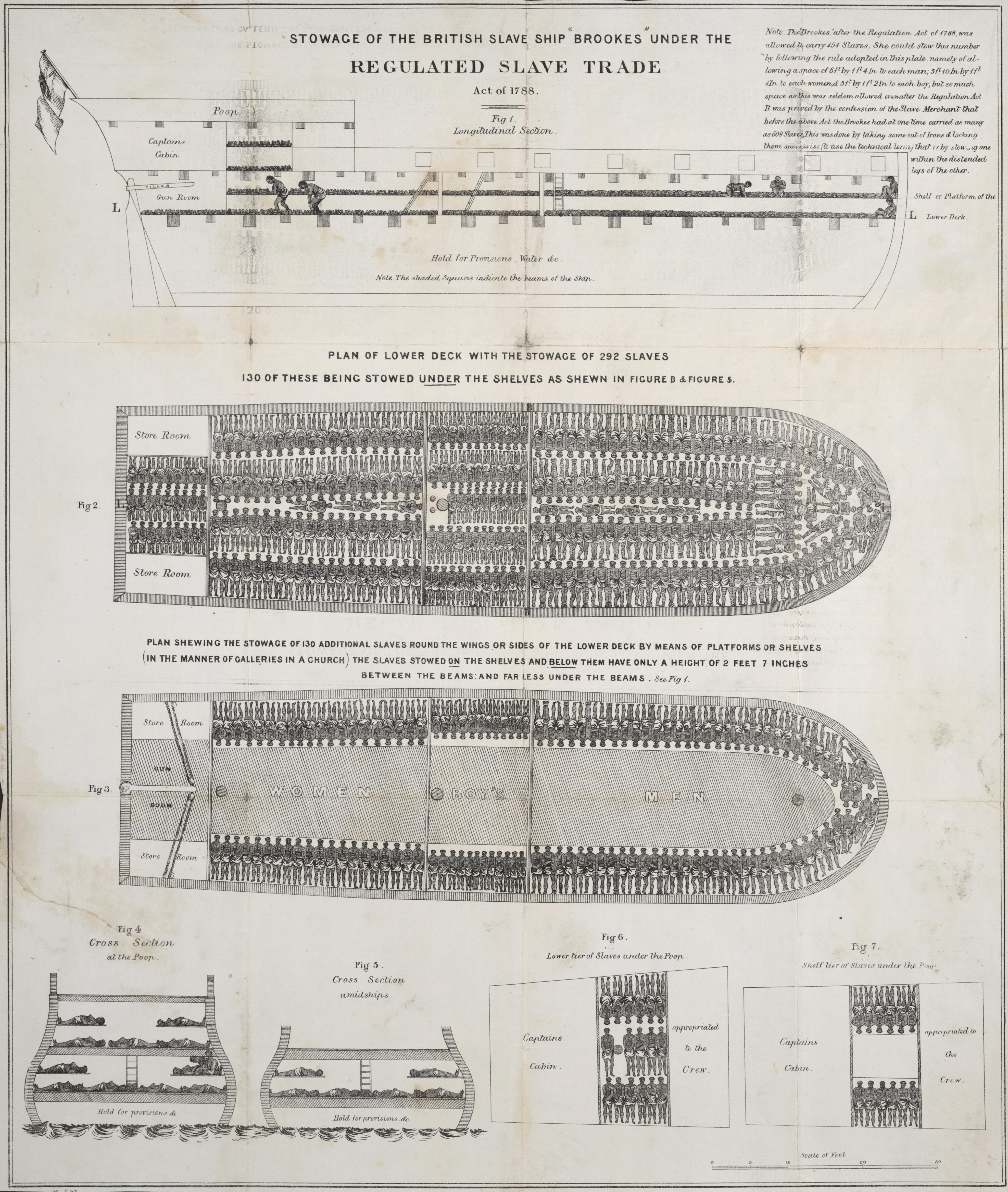
Image showing the stowage of slaves under the "Regulated Slave Trade Act of 1788"
https://upload.wikimedia.org/wikipedia/commons/8/82/Slaveshipposter.jpg
Click to blow up the image to see additional detail.
"For He's a Jolly Good Fellow": This tune became popular in the early 18th century by association with the French song "Marlborough s'en va-t-en guerre" ("Marlborough Has Left for the War"), a burlesque on the false report of the Duke of Marlborough's death at the battle of Malplaquet in 1709. Here's a recording of the tune with the French lyrics: http://www.youtube.com/watch?v=YqRpPMOaMIA
And, as a reminder, Adam Smith's Theory of Moral Sentiments argues that:
"How selfish soever man may be supposed, there are evidently some principles in his nature, which interest him in the fortune of others, and render their happiness necessary to him, though he derives nothing from it except the pleasure of seeing it. Of this kind is pity or compassion, the emotion which we feel for the misery of others, when we either see it, or are made to conceive it in a very lively manner."
https://upload.wikimedia.org/wikipedia/commons/8/82/Slaveshipposter.jpg
Click to blow up the image to see additional detail.
"For He's a Jolly Good Fellow": This tune became popular in the early 18th century by association with the French song "Marlborough s'en va-t-en guerre" ("Marlborough Has Left for the War"), a burlesque on the false report of the Duke of Marlborough's death at the battle of Malplaquet in 1709. Here's a recording of the tune with the French lyrics: http://www.youtube.com/watch?v=YqRpPMOaMIA
And, as a reminder, Adam Smith's Theory of Moral Sentiments argues that:
"How selfish soever man may be supposed, there are evidently some principles in his nature, which interest him in the fortune of others, and render their happiness necessary to him, though he derives nothing from it except the pleasure of seeing it. Of this kind is pity or compassion, the emotion which we feel for the misery of others, when we either see it, or are made to conceive it in a very lively manner."
"As we have no
immediate experience of what other men feel, we can form no idea of the manner
in which they are affected, but by conceiving what we ourselves should feel in
the like situation."
Humanity and Motherhood in The History of Mary Prince
The account of the first time Mary Prince is sold with her sisters at a slave auctions is one of the most disturbing narratives in The History of Mary Prince. The very first stage of selling Mary involves the removing of her clothes and replacing them with a "osnaburg" (589). Both of her sisters are given the same coarse linen to wear. The sisters are given these osnaburgs to remove any evidence of their humanity to bidders at the auction. Mrs. Williams, Miss Betsey, and Mrs. Pruden most likely would have allowed Mary to wear articles of clothing that were especially hers. The removing of these items represents the removing of Mary's humanity to erase any guilt white bidders might have during the auction. Dressing Mary in the same clothes as all the other slaves at auction destroys her individuality. It makes the slaves seem more livestock like to the white bidders. However Mary's mother's presence at the auction demands that white bidders see them as human.
It is incredibly disturbing that Mary's mother is the one who walks them to the auction and even places them "in a row against a large house, with [their] backs to the wall" (590). This situation is so disturbing to read about because it is such a human moment. The girls have been set up as nothing more than livestock, but their mother is present because it is her duty as a mother to watch over them until she no longer can. This account is parallel to a dying person surrounding their death bed with loved ones. Humans want to be surrounded by those they love in horrible times and the presence of Mary's mother at the auction proves both their humanity and similarity to people of all races. Mary's mother standing next to her daughters at the auction forces the bidders to see them as people. Perhaps this is another reason Mary's mother wants to be present at the auction. She is trying to create sympathy for her daughters to be sold into kind homes. However this attempt fails and exhibits how immune to attempts of humanization the white bidders are.
It is incredibly disturbing that Mary's mother is the one who walks them to the auction and even places them "in a row against a large house, with [their] backs to the wall" (590). This situation is so disturbing to read about because it is such a human moment. The girls have been set up as nothing more than livestock, but their mother is present because it is her duty as a mother to watch over them until she no longer can. This account is parallel to a dying person surrounding their death bed with loved ones. Humans want to be surrounded by those they love in horrible times and the presence of Mary's mother at the auction proves both their humanity and similarity to people of all races. Mary's mother standing next to her daughters at the auction forces the bidders to see them as people. Perhaps this is another reason Mary's mother wants to be present at the auction. She is trying to create sympathy for her daughters to be sold into kind homes. However this attempt fails and exhibits how immune to attempts of humanization the white bidders are.
Esmeralda Rodriguez
Cowper’s poem gives a sort of teasing tone,
such as when saying “curious assortment of dainty regales” (line 11). In other
words, sweet talking “negroes” more than likely with false promises in order to
have them board the ship. Then adorning “fine chains around the neck” (line 13)
and using “a cat with nine tails”, a whip, perhaps to force slaves into
submission.
Barbauld says in her poem, “Forced her averted
eyes his stripes to scan/Beneath the bloody scourge laid bare the man” (line
7-8). The “stripes”, or opened wounds caused by the lash, would be gruesome,
enough to make Barbauld turn away.
What is interesting about Cowper’s poem
however, is how he writes “which nobody can deny” after each and every verse.
As if saying “I cannot make this up”. The pictures painted throughout the poem,
through every stanza, give an insight as to what happened on slave ships. Such
as line 30 through 34, seeing the slaves lying on their back in the deck below.
And also, part of Cowper’s poem, is the
various tools or methods used on slaves to weaken and have them submit. Such as
“supple-jack” and “rat-tan” (line 15), which were used as switches or canes;
also “padlocks and bolts, and screws fir the thumbs” (line 19), which would be
like shackles tightening around their skin until they bled; and finally, “victuals
withdraws” (line 23) or starvation.
What Cowper does is vividly depict the horrors
and atrocity that went on in these ships, and although sounding mocking or
playful with the rhyming scheme and the consistent song-like “which nobody can
deny”, it does not denote the fact these were events and tools and methods
frequently used on slaves.
Thursday, November 10, 2016
Felicia Hemens
The Effigies
This poem starts out telling us about the way a fallen hero
is remembered and honored for his actions. He is rewarded for his actions in
battle by fame. The woman he left behind is not honored for her actions. While
he is at battle she continues to tend to his home (line 43-44), prays for his
safety (line 45) and waits for him to return (line 48). None of her actions are
celebrated although in losing her knight she has also made a great sacrifice
for her homeland. Not only is her sacrifice
just as great but a death in battle requires a great heroic moment while she
has to live her sacrifice day in day out for the rest of her life.
The argument could also be made that his fame is temporary.
The poem mentions that his name is “faded from the stone” (lines 5-6) and that
the speaker has to trace his deed “through a cloud of years.” (lines 7-8) At
this point our warrior is still remembered but the world is starting to forget
him. We are given vague descriptions of his heroic deeds (lines 9-16) and we
are told that the leaders celebrated his deeds. I wonder if she is also
criticizing the leaders who order men into battle from their safe, lofty
positions (lines 17-18) and who celebrate the victories with “blood-red wine”
(line 20) with little thought to the individual lives that are impacted by these
actions.
The Image in Laura
This poem made me think of the discussion in class on
Tuesday over “The Skylark.” Shelley was writing about achieving “unpremeditated
art” a higher form of art than something purposefully created by following our
established blueprints for building something artistic. It seems to me that
Hemans is arguing that this woman who died trying to protect her child from the
volcanic eruption at Herculaneum achieved just that. She compares the
impression to manmade art multiple times (lines 9-12, 33-36) to show us that
there is no comparison. This impression tells us more about human love (lines
37-41) and sacrifice (lines 21-24) than a state-commissioned piece of art ever
could. We don’t know who this woman was
but her actions left an impression upon the very earth.
Woman and Fame
This poem goes into the fleetingness and fickleness of fame.
The first few stanzas go into the allure of fame. It tells us about how people
strive for it and how it calls to us. Many look at as a path to a sort of
immortality. Women are denied access to this kind of fame and are confined to
the domestic sphere (lines 17-18 and the quote before the poem). At the same
time she questions if fame is worth pursuing. She refers to it as “hollow” and
questions what it really does to enrich us. Fame doesn’t live up to what it
promises us.
11/10 Hemans
Though all of Felicia Hemans' poetry assigned contains the immortalizing of women, The Effigies pulled at me the most. Her connection between the Warrior and the Woman, and how they were each immortalized is what pulled at me the most.
The Warrior is immortalized not just by his tomb, not by his name, but through his heroic acts. Everything else about him has been lost to time, but the heroic story of what he done can be traced back to him. His tomb is just another dedication to his acts as the Warrior.
The Woman, however, her heroic deeds are not immortalized with the tomb, but her place by the Warrior side. We do not know her story, but the poem assumes that her place beside the Warrior was full of grief. While the Warrior lives through a tale of victory, her tale can only be a tale of woe unable to stand against the test time. We remember these great Warriors that fight heroic battles, but the women who stand beside them sacrifice not their lives, but their hearts, their stories fade and only the Warrior's acts remain. No songs are sung about them. When their name fades from history. their acts of love and sacrifice are not immortalized. Their tomb beside the Warrior's is the only tribute to them and it is a tribute to their place beside the Warrior. The Effigies does not tell you the story of the Warrior, it tells the story of the Woman and gives her the praise history chose to forget.
The Warrior is immortalized not just by his tomb, not by his name, but through his heroic acts. Everything else about him has been lost to time, but the heroic story of what he done can be traced back to him. His tomb is just another dedication to his acts as the Warrior.
The Woman, however, her heroic deeds are not immortalized with the tomb, but her place by the Warrior side. We do not know her story, but the poem assumes that her place beside the Warrior was full of grief. While the Warrior lives through a tale of victory, her tale can only be a tale of woe unable to stand against the test time. We remember these great Warriors that fight heroic battles, but the women who stand beside them sacrifice not their lives, but their hearts, their stories fade and only the Warrior's acts remain. No songs are sung about them. When their name fades from history. their acts of love and sacrifice are not immortalized. Their tomb beside the Warrior's is the only tribute to them and it is a tribute to their place beside the Warrior. The Effigies does not tell you the story of the Warrior, it tells the story of the Woman and gives her the praise history chose to forget.
Wednesday, November 9, 2016
Felicia Hemans
I found it interesting how all of Hemans' poems that we read had something to do with immortalizing the memory of long-deceased woman. I know on Tuesday how we talked about how she, Shelley and Keats we all interested in their own mortality and memory, but that still didn't prepare me for the way her poems seemed to say "Hey, women are awesome and deserve to be revered long after their deaths."
Mostly, I was interested in how--aside from "Woman and Fame"--her poems all seem to be about other women. In fact, the women in "Effigies" and "Lava" don't even have names, but Hemans sought to write about them all the same. By comparison, the works we read by Keats and Shelley (to a lesser extent) we focused on themselves. I wondered what it might be that made Hemans call attention to the memories of these other women. Was it a sort of quid pro quo, where if she wanted her own place in popular memory she should make sure to remember other women?
I also found it interesting that she embraces femininity in the poems. In "Effigies" she unironically calls the woman in the statue "gentle" and praises her presumed devotion to her husband. In "Lava," she gushes about maternal affection. Neither of these seem snide in any way, but rather comign from a deep respect for these "feminine" traits. But perhaps I'm only getting the surface sensations again.
Mostly, I was interested in how--aside from "Woman and Fame"--her poems all seem to be about other women. In fact, the women in "Effigies" and "Lava" don't even have names, but Hemans sought to write about them all the same. By comparison, the works we read by Keats and Shelley (to a lesser extent) we focused on themselves. I wondered what it might be that made Hemans call attention to the memories of these other women. Was it a sort of quid pro quo, where if she wanted her own place in popular memory she should make sure to remember other women?
I also found it interesting that she embraces femininity in the poems. In "Effigies" she unironically calls the woman in the statue "gentle" and praises her presumed devotion to her husband. In "Lava," she gushes about maternal affection. Neither of these seem snide in any way, but rather comign from a deep respect for these "feminine" traits. But perhaps I'm only getting the surface sensations again.
Subscribe to:
Posts (Atom)